
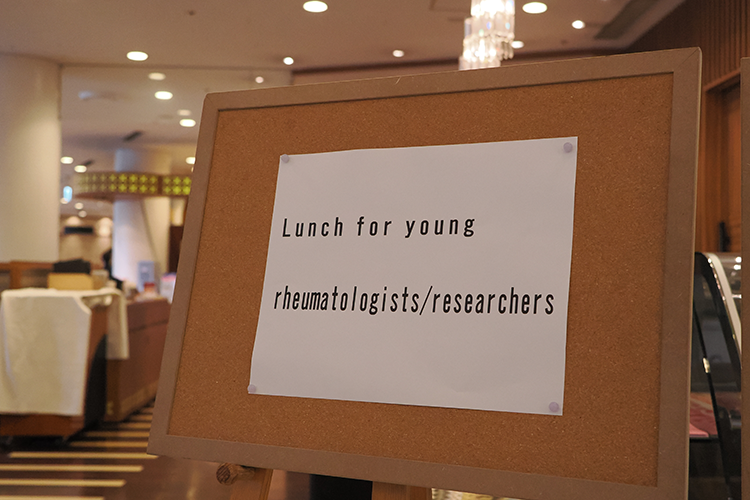
Lunch for young rheumatologists/researchers (J-STAR Lunch)
Deputy Chairperson
Haruka Tsuchiya
The University of Tokyo Hospital Vice Chair, J-STAR-IR Committee AYR borad member
One of the highlights of attending the JCR Annual Scientific Meeting was the J-STAR lunch, where young rheumatologists from Japan and overseas could meet and talk in a relaxed and friendly atmosphere.
Our conversations went far beyond clinical practice and research. We exchanged ideas about career development, discussed differences in working environments across countries, shared experiences and advice about studying or working abroad, and even talked about our favorite places to visit and foods to try in Japan.
What made the gathering particularly special was that these conversations led to genuine friendships and professional networks that continued well beyond the meeting.
If you are considering attending the JCR Annual Scientific Meeting, I strongly encourage you to join us. JCR offers more than scientific presentations and the latest advances in rheumatology—it is also a place to gain new perspectives, make meaningful connections, and build friendships that last beyond the meeting.
Come to JCR and discover what awaits beyond the scientific sessions!
Committee
Taiga Kuga
Juntendo University
The networking session was a valuable opportunity to learn about the career paths of our international colleagues. Some of the overseas faculty are active on the global stage, and others studied abroad before coming to the JCR meeting. Being able to talk with them in person was very worthwhile. I also met a few speakers who were attending for the second time. Repeat participants still seem to be a minority, but it was encouraging to see them.
Sho Sendo
Kobe University Hospital
The J-STAR Lunch provided a valuable opportunity to interact with young rheumatologists and researchers from the APLAR, EULAR, and ACR communities, as well as from other regions around the world. Through these discussions, I was able to learn about differences in rheumatology practice across countries, while also sharing our experiences in Japan. Following the lunch, the J-STAR Session provided a further opportunity to discuss the pathophysiology of rheumatic diseases and approaches to difficult-to-treat conditions through case-based discussions from both clinical and basic research perspectives.
Most importantly, the connections established through J-STAR have extended beyond the JCR Annual Meeting, leading to opportunities to participate in international rheumatology meetings and opening the door to future research collaborations. It was also a pleasure to introduce our international colleagues to Japanese culture and places to visit. I believe that the combination of the J-STAR Lunch and Session provides a unique platform for young rheumatologists and researchers to exchange ideas, learn from one another, and build lasting international networks through the JCR Annual Meeting.
Tsuneyasu Yoshida
Cedars Sinai Medical Center Kao immunity institute
Attending an international conference can be exciting, but also a little intimidating, especially when you arrive in a new country surrounded by unfamiliar faces. The J-STAR Lunch has a wonderful way of changing that. By the end of lunch, some of those unfamiliar faces have already become people you can greet in the hallway, sit next to at the next session, and reconnect with later in the meeting.
What I particularly enjoyed was the relaxed atmosphere. The conversation naturally went beyond rheumatology itself, touching on research, training, working in different countries, life abroad, and of course, life in Japan. These informal exchanges offered something that is often difficult to find in a lecture hall: a genuine sense of how colleagues from different backgrounds think, work, and experience medicine in their own settings.
For me, this is one of the real strengths of the J-STAR Lunch. It makes an international meeting feel smaller in the best possible way. Once you have shared a table and a few stories with someone, it becomes much easier to continue the conversation afterwards. Some of these encounters may remain pleasant memories, while others can develop into lasting friendships, professional networks, or future collaborations.
A Travel Award may help you get to the JCR Annual Scientific Meeting, but the people you meet there may be what you take home with you.
So, if you are coming to JCR from overseas and wondering whether you will know anyone there, come and join us for lunch. You may arrive without knowing many people, but hopefully, you will not leave that way.
Member
Shinji Izuka
The University of Tokyo
JCR is not only a great opportunity to present research and gain new scientific knowledge, but also a valuable place to connect with rheumatologists from around the world. I have participated in the networking lunch at JCR meetings in Kobe and Fukuoka over the past few years. The relaxed atmosphere makes it easy to exchange ideas, meet new colleagues, and reconnect with friends I first met at international meetings such as EULAR, ACR, and APLAR. These conversations have been some of the most memorable parts of the meeting. These connections often continue beyond a single conference and can open the door to future collaborations and research opportunities. I believe this international community is one of the unique strengths of attending JCR, especially for young rheumatologists from overseas.
Toshiki Kido
University of Toyama
The J-STAR lunch gathering was an exciting opportunity to exchange ideas with inspiring young rheumatologists from around the world. As someone just starting my research journey, I found it truly motivating!
Whether you are early in your career or more experienced, we look forward to welcoming you to Japan. Be sure to visit the J-STAR-IR booth for snacks from across Japan, traditional Japanese games, and friendly conversations with our members in their JCR happi coats. See you at JCR!